How Do LEDs Wear Out? Light Depreciation, L70 and Thermal Management
LEDs normally fade gradually rather than burning out like incandescent lamps. Their useful life depends on junction temperature, drive conditions, component quality and the quality of the complete installation, including heat dissipation.
An LED is not a permanent light source, but it ages differently from an incandescent lamp. In a correctly designed installation, the usual effect is gradual loss of light output. A single LED or an entire section going dark without warning is more often linked to a connection, power supply, overheating or assembly issue than to normal semiconductor ageing.
Real-world service life belongs to the whole system, not just the LED chip. The package, PCB, solder joints, wiring, driver or power supply, controller, enclosure and thermal path all matter. For that reason, a lifetime figure on its own is not enough to compare lighting products.
What is inside an LED?
An LED contains a semiconductor p-n junction. When forward current flows, electrons and holes recombine, and part of the energy is released as light. The semiconductor materials and the LED package design determine the light colour and many operating characteristics.
Coloured LEDs
A conventional red, green or blue LED generates its colour directly in the semiconductor structure. The emitted light then passes through a lens or encapsulant. RGB packages generally contain separate dies for each channel. Since the channels can age at different rates, long-term use may cause a small shift in white balance or mixed-colour output.
White LEDs
Most white LEDs combine a blue-emitting semiconductor with phosphor. Some blue light excites the phosphor, which emits longer wavelengths; together, these components are perceived as white light. As a result, the chip is not the only part that affects lumen maintenance and colour stability. The phosphor, silicone encapsulant, lens and package sealing are also important.
A package designation such as SMD 3528, 2835 or 5050 does not, by itself, indicate lifetime or quality. It primarily identifies a package family and physical format, rather than the materials, operating conditions or manufacturing standard. For a comparison of common package types, see SMD 3528 versus SMD 2835; for larger packages, read our guide to 5050 LEDs.
What does LED degradation involve?
The defining ageing effect in LEDs is lumen depreciation: at the same drive current, the LED produces less light over time. A shift in chromaticity, perceived as a slight change in tint, may also occur.
Electrical, thermal and optical ageing processes take place at the same time within an LED package. Their rate depends strongly on the operating environment.
- High junction temperature accelerates ageing in semiconductor materials, phosphor and optical components.
- Excessive drive current raises temperature and stresses the die. It may increase initial brightness, but generally reduces useful life.
- Frequent thermal cycling makes dissimilar materials expand and contract. Over time, this can weaken internal bonds and PCB solder joints.
- Moisture, contamination and aggressive environments can corrode connections, reduce insulation performance and affect optical materials.
- Heat and radiation exposure can gradually alter the clarity of lenses or encapsulants and the properties of phosphor materials.
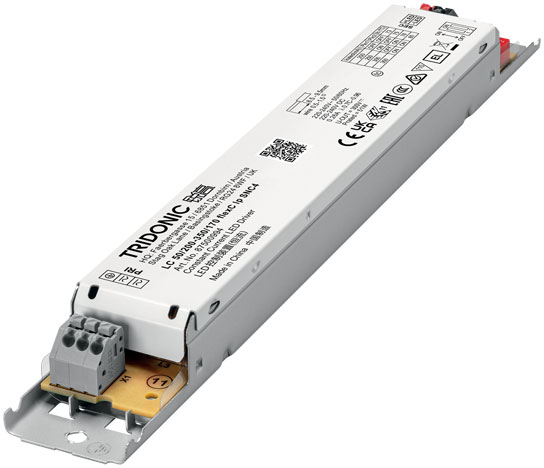
Parts outside the LED package are equally relevant. On an LED strip or in a luminaire, PCB quality, copper content, soldering and electrical connections all affect reliability. In a driver or power supply, temperature-sensitive components, including capacitors, may determine when the assembly fails. A failed driver can switch off a luminaire whose LEDs are still capable of operating.
Temperature is the key lifetime factor
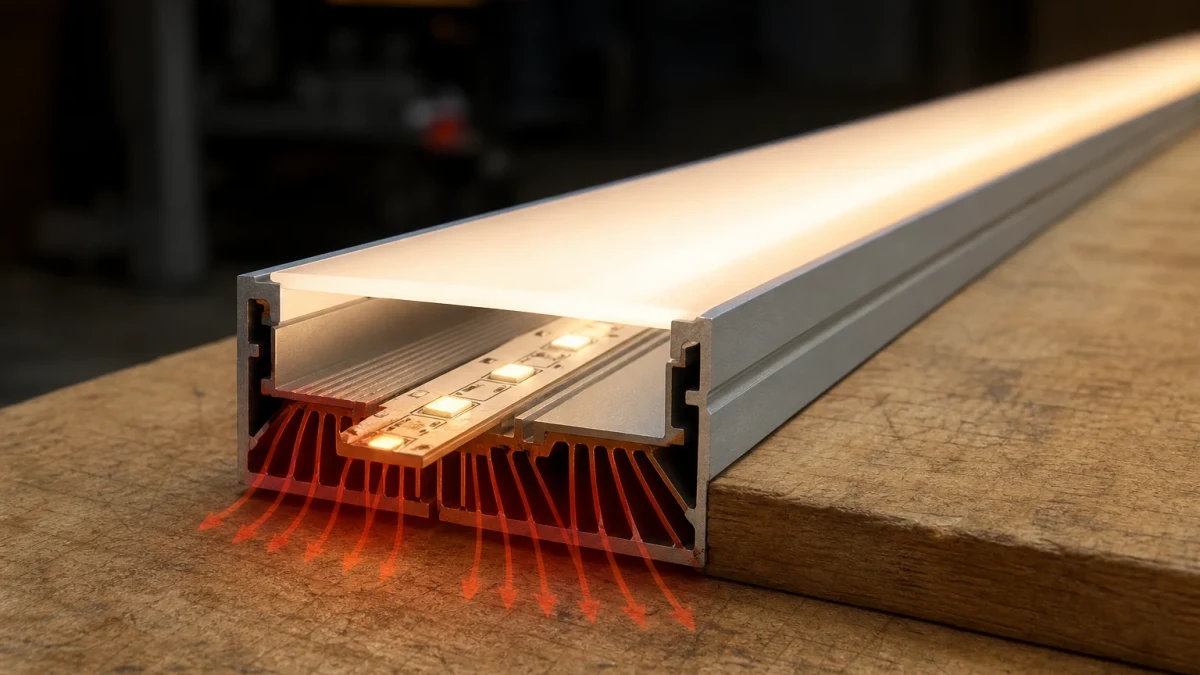
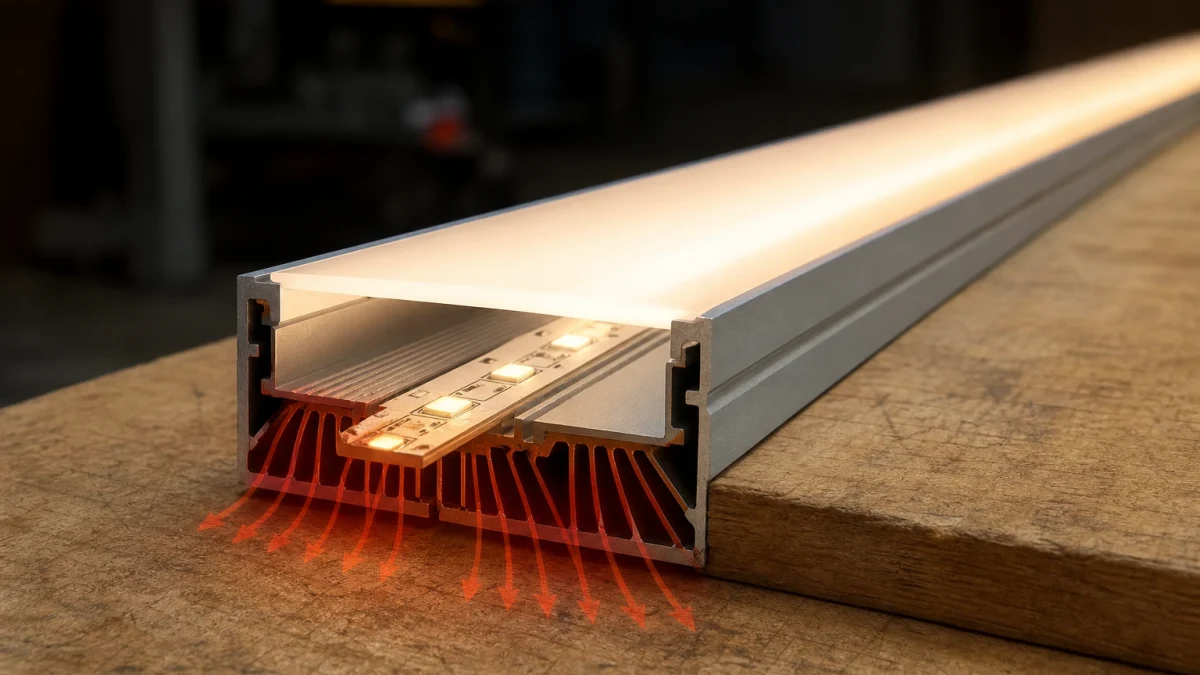
Not all electrical input to an LED becomes light; much of it becomes heat. That heat must travel from the semiconductor junction through the package and PCB into a heat sink, aluminium profile or luminaire body, and then into the surrounding air. Any weak point in this path raises junction temperature.
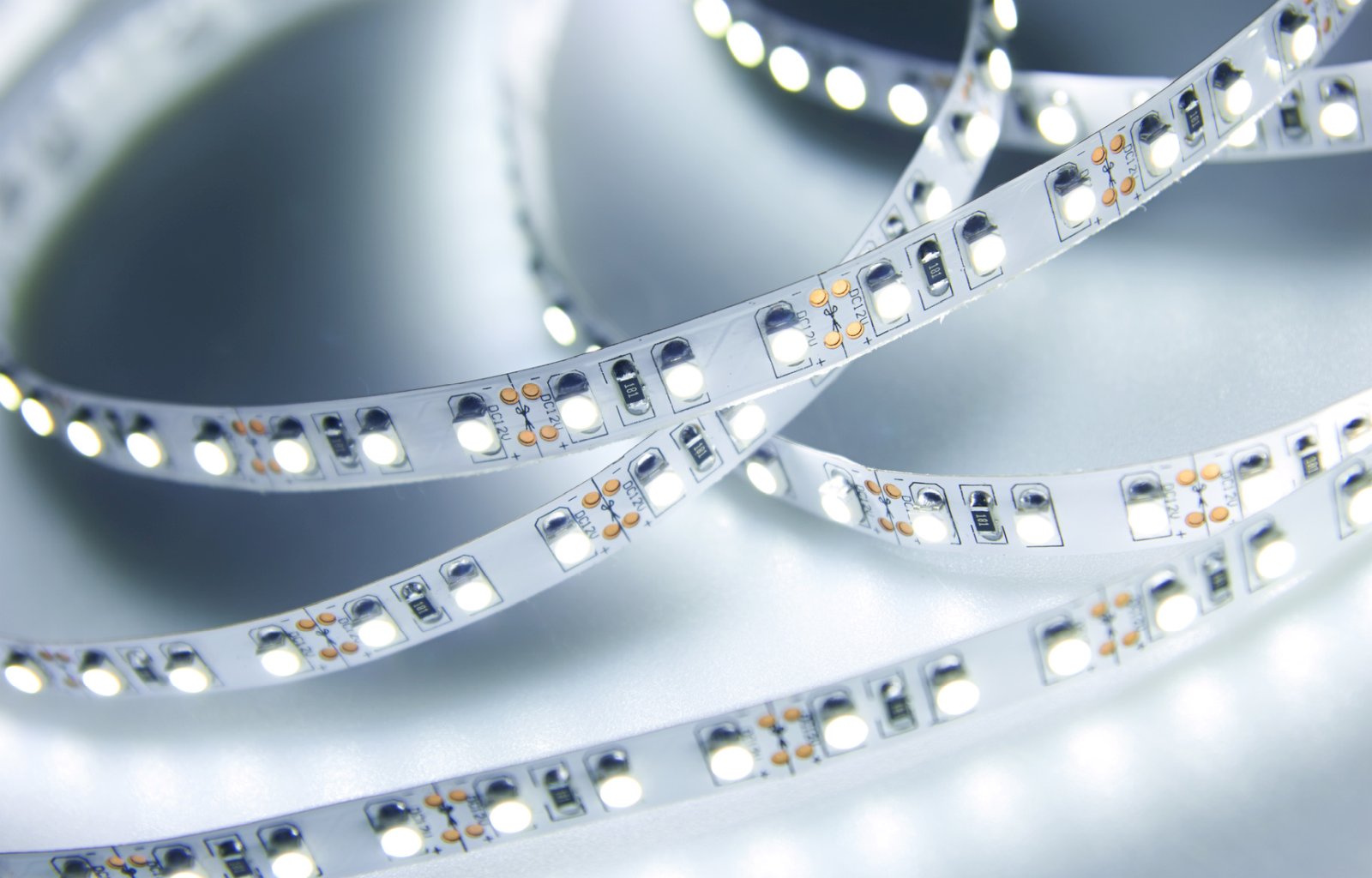
With LED strip installations, a common mistake is fixing a higher-power strip directly to furniture board, plasterboard or plastic, all of which are poor heat sinks. A suitably sized aluminium profile is not merely a finishing detail: it enlarges the heat-dissipating surface and helps keep operating conditions stable. The power supply also needs ventilation, and luminaires should not be enclosed contrary to their installation instructions.
Cooler operation does not guarantee identical service life for every product. It is, however, one of the most effective ways to slow lumen depreciation and reduce the risk of early failure.
What do L70, L90 and L70B50 mean?
LED lifetime ratings normally describe light-output maintenance over time, not the point at which a source stops emitting light completely.
| Rating | Practical meaning |
|---|---|
| L90 | The time at which light output is expected to reach 90% of its initial value. |
| L80 | The time to 80% of initial light output. |
| L70 | The time to 70% of initial light output, commonly used as a useful-life threshold. |
| L70B50 | At the stated time, at least 50% of the tested population retains at least 70% of initial light output. |
The L value is the maintained luminous-flux level. The B value describes the share of a product population that may fall below that level. L70B50 does not mean that half of the products stop working. It describes the spread of lumen depreciation in the population. L70B10 is a more demanding declaration than L70B50 because fewer products are permitted to fall below 70% output.
Always consider the declared test conditions as well: ambient temperature, case or test-point temperature, drive current, operating duration and extrapolation method. Package data obtained through methods such as LM-80 testing and TM-21 projections cannot automatically be treated as the lifetime rating of a complete luminaire. The finished product has its own thermal, optical and power-electronics limitations.
Why does an LED system fail suddenly?
Gradual dimming is normal LED ageing. Sudden blackout calls for diagnosis of the complete installation. Common causes include:
- a failed, overloaded or poorly ventilated power supply or driver;
- voltage drop on an excessively long strip run supplied from only one end;
- a loose terminal, poor solder joint, broken cable or oxidised connector;
- mechanical damage during cutting, installation or bending of the strip;
- overheating caused by no heat sink, an enclosed space or excessive power density;
- a surge, incorrect supply type or incompatible controller;
- moisture reaching components that are not adequately protected for the environment.
An individual LED can also fail because of electrostatic discharge, an internal bonding defect or severe electrical overstress. However, abrupt failure should not be viewed as the normal end-of-life behaviour of an LED. Sound assembly, good connections and correctly matched components are fundamental to reliable operation.
How to design for long service life
- Select the correct power arrangement. 12 V and 24 V strips require a constant-voltage power supply, while modules and luminaires designed for current operation need a compatible constant-current driver. Read how to choose the right LED power supply for the selection basics.
- Do not overload the supply. Calculate the load for the full installation length and allow sensible power headroom suited to the operating conditions.
- Create an effective thermal path. Use an appropriate aluminium profile for higher-power strips, and do not obstruct heat dissipation from the luminaire or power supply.
- Plan feeds for long runs. Add power-feed points where calculations require them to limit voltage drop and uneven brightness.
- Match ingress protection to the location. An IP rating does not replace properly sealed connections or protection of the power supply from water and condensation.
- Keep service components accessible. Drivers and controllers should be inspectable and replaceable without dismantling the entire installation.
For ceiling-cove installations, profile selection, cooling, service access and correct power feeding all need to be planned together. Our guide to installing LED strip in a ceiling cove explains the practical details.
Conclusion
LEDs primarily wear out through gradual light-output loss and, in some cases, a change in colour. Actual service life is not set by one hour rating or an SMD package size. It depends on LED package quality, thermal control, correct power supply selection and careful installation. When quality components are properly cooled, powered and installed with service access in mind, ageing is more predictable and lighting performance remains stable for much longer.
Contact us — we will help you choose the right solution
Choose your preferred contact method