- Online only


LED strip SMD 3528 12V 4.8W/m red 60LED/m IP20 5m
| LED technology | SMD |
|---|---|
| LED package | 3528 |
| Light type | single colour |
| Power supply | 12 V DC |
| Power | 4.8 W/m |
| Current consumption | 0.4 A/m |
| LED density | 60 LED/m |
| Channels no. | 1 channel |
| IP rating | IP20 |
| Warranty | 2 years |
| Sales unit | reel, 5 m |
| Quality tier | standard |
| LED technology | SMD |
|---|---|
| LED package | 3528 |
| Light type | single colour |
| Power supply | 12 V DC |
| Power | 4.8 W/m |
| Current consumption | 0.4 A/m |
| LED density | 60 LED/m |
| Channels no. | 1 channel |
| IP rating | IP20 |
| Warranty | 2 years |
| Sales unit | reel, 5 m |
| Quality tier | standard |
 Delivery
1-3 dni (PL), 3-10 dni (non-PL)

Privacy Policy
 Return Policy
14 days
The strip uses SMD technology with LEDs in a 3528 package. The underside has factory-applied double-sided adhesive tape to aid installation on a suitably prepared surface.
The strip can be powered directly from a suitable 12V power supply. An optional PWM controller enables brightness adjustment.
The stated power is a rated or theoretical value based on the parameters of the components used. Actual power consumption may be lower due to component tolerances, voltage drop and operating conditions.
The strip does not require an additional power-injection point when its length does not exceed 5m. Above this length, consider starting the next separately powered run, supplying the run at its far end, or adding another power point after the indicated length.
The 5m value is based on the electrical properties of the strip PCB. It indicates the length at which supply-voltage drop should not cause a noticeable reduction in LED brightness along the length of strip. Above this length, a brightness difference may become visible. If it remains acceptable to the end customer, the final power-feed arrangement is the responsibility of the installation designer or user.
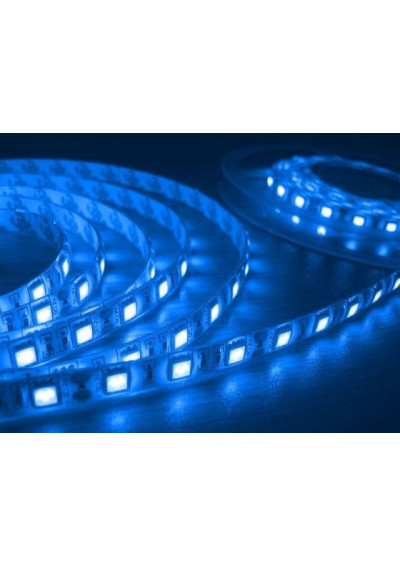
A single-color mono LED strip emits red light. It is a single-channel light source — all LEDs operate together, without independent color mixing. The mono LED strip family includes, among others, red, green, blue, violet, pink, amber, yellow, UV, and near-UV models.
The color of the emitted light depends on the spectral distribution of the LED radiation, characterized among other parameters by its dominant or peak wavelength. Red and amber belong to the long-wavelength region of the visible spectrum, yellow and green occupy its middle range, while blue and violet are located toward the short-wavelength, higher-frequency end. UV radiation lies outside the visible spectrum, whereas near-UV is located close to its boundary and may be perceived as deep violet while strongly exciting fluorescence in certain materials.
Red, green, and blue are the primary colors of the additive RGB color model. In multi-channel systems, mixing them makes it possible to produce secondary colors — for example, yellow from red and green, and magenta or pink from red and blue. This does not mean, however, that a single-color yellow, amber, or violet strip mixes RGB channels. In a mono strip, the specified color is produced directly by the LEDs used or by their specifically engineered spectral characteristics. Pink and magenta are non-spectral colors — they do not correspond to a single wavelength, but rather to a specific combination of spectral components. Spectral violet, on the other hand, can be produced directly in the short-wavelength region of visible light.
Perceived brightness depends not only on radiant power, but also on the sensitivity of human vision. Under photopic, or daylight, vision conditions, maximum sensitivity occurs near 555 nm. For this reason, yellow-green and green light may appear particularly intense at the same optical power. Under scotopic, or night-vision, conditions occurring at very low illumination levels, peak sensitivity shifts toward approximately 507 nm, in the blue-green region. Red and amber then become relatively less visible.
Blue light has a very distinctive appearance and is highly effective at attracting attention, particularly in large, simple shapes viewed from a greater distance. At low luminance, however, small blue elements may appear less sharp, slightly blurred, or surrounded by a visible halo. This results, among other factors, from the chromatic aberration of the human eye and reduced visual acuity in the short-wavelength region of the spectrum. For this reason, blue is not the best choice for small lettering, thin outlines, or complex symbols where maximum sharpness and detail legibility are critical. It performs very well, however, as a strong signaling and decorative accent.
For static operation, a mono LED strip does not require a controller — it only needs to be connected to a correctly selected power supply. Light intensity adjustment requires a compatible single-channel LED dimmer or controller, most commonly using PWM modulation. In the case of UV and near-UV strips, the model should be selected primarily according to its actual wavelength and intended application, because apparent brightness is not a reliable measure of radiant power.
The strip operates at 12V and has a density of 60LED/m with an IP20 ingress-protection rating.
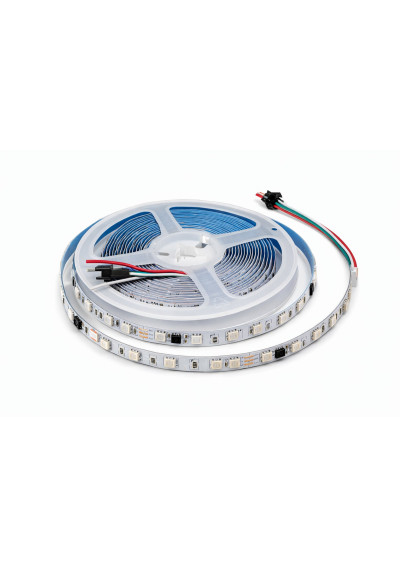
The sales unit includes a factory-prepared reel of LED strip with a length of 5m.
The strip requires a power supply with an output voltage of 12V. Guidance: select a power supply with an optimum 30% power reserve above the LED strip demand.
Choose the red LED strip 300LED SMD 3528 when you need clear, stable red light and sensible power use. This version balances diode density with efficiency. It works well for decorative lines, signage, and subtle backlighting. SMD 3528 chips deliver consistent color and smooth illumination. The strip is easy to adapt, because you can cut it at marked points. Install it in an aluminium profile for better cooling and a cleaner finish.
Use a constant-voltage LED power supply matched to the strip wattage. Add a 20–30% safety margin for long-term reliability. Look for protection features like OVP, OCP, SCP, and OTP. Models with active PFC often run cooler and more stable.
Long runs can dim at the end due to voltage drop. Add power injection to keep brightness even. For 12V systems, feed power about every 5 m. For 24V systems, feed power about every 10 m. Use a star wiring layout and proper cable gauge. Seal connections if installed near moisture.
Clean and degrease the surface before mounting. The adhesive backing helps with quick placement, but an aluminium profile improves heat dissipation. Cut only at the designated cut marks. You can connect sections using soldering or quality connectors. For outdoor use, choose the right IP protection level and protect all joints.
Which power supply should I choose?
Calculate total wattage of all sections and add 20–30%. Pick a unit with OVP/OCP/SCP/OTP protections.
When do I need power injection?
Use it for long runs or when you need uniform brightness. Feed every 5 m (12V) or 10 m (24V).
Can I cut and reconnect the strip?
Yes, only at cut points. Soldering gives the most reliable connection for demanding installs.
Explore matching accessories: LED strips | LED power supplies | Controllers & dimmers.
Order today at LEDownia.pl and build a reliable, premium red lighting line with expert support.

Data sheet