- Online only


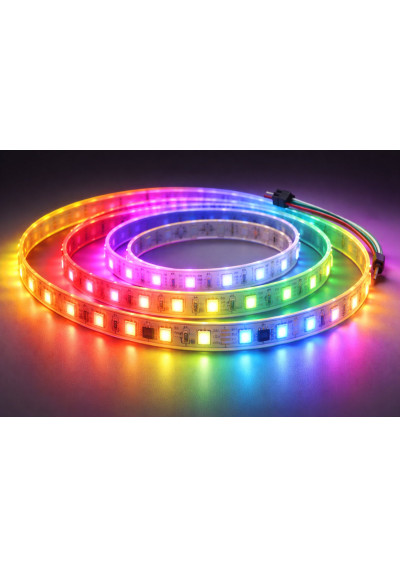
LED strip SMD digital WS2811/SPI 24V ARGB 60LED/m IP20 1m
| LED technology | SMD |
|---|---|
| LED package | 5050 |
| Light type | RGB |
| Power supply | 24 V DC |
| Power | 14.4 W/m |
| Current consumption | 0.6 A/m |
| LED density | 60 LED/m |
| Chipset | WS2811 |
| Control protocol | SPI |
| Channels no. | 1 data line |
| Pixel density | 10 pixels/m |
| LEDs per pixel | 6 LEDs/pixel |
| PCB width | 10 mm |
| Cutting module | 100 mm |
| IP rating | IP20 |
| Warranty | 2 years |
| Sales unit | metre, 1 m |
| Quality tier | standard |
| Cutting mode | fixed interval |
| LED technology | SMD |
|---|---|
| LED package | 5050 |
| Light type | RGB |
| Power supply | 24 V DC |
| Power | 14.4 W/m |
| Current consumption | 0.6 A/m |
| LED density | 60 LED/m |
| Chipset | WS2811 |
| Control protocol | SPI |
| Channels no. | 1 data line |
| Pixel density | 10 pixels/m |
| LEDs per pixel | 6 LEDs/pixel |
| PCB width | 10 mm |
| Cutting module | 100 mm |
| IP rating | IP20 |
| Warranty | 2 years |
| Sales unit | metre, 1 m |
| Quality tier | standard |
| Cutting mode | fixed interval |
 Delivery
1-3 dni (PL), 3-10 dni (non-PL)

Privacy Policy
 Return Policy
14 days
The strip uses SMD technology with LEDs in a 5050 package. The underside has factory-applied double-sided adhesive tape to aid installation on a suitably prepared surface.
The WS2811 chipset controls the pixels digitally. To use the digital functions, the strip requires a compatible controller supporting the specified chipset and data-transmission method.
The stated power is a rated or theoretical value based on the parameters of the components used. Actual power consumption may be lower due to component tolerances, voltage drop and operating conditions.
The strip does not require an additional power-injection point when its length does not exceed 10m. Above this length, consider starting the next separately powered run, supplying the run at its far end, or adding another power point after the indicated length.
The 10m value is based on the electrical properties of the strip PCB. It indicates the length at which supply-voltage drop should not cause a noticeable reduction in LED brightness along the length of strip. Above this length, a brightness difference may become visible. If it remains acceptable to the end customer, the final power-feed arrangement is the responsibility of the installation designer or user.
An RGB LED strip uses three independent color channels: red, green, and blue. By adjusting their relative brightness levels, it is possible to produce a very wide range of colors, including smooth color transitions, dynamic lighting effects, and white light created by activating all three channels simultaneously. Red, green, and blue are the primary colors of the additive color model, and the characteristics of red, green, and blue LEDs are stable, repeatable, and well understood — which is why these particular colors are used.
The strip requires a compatible 3-channel RGB controller that independently regulates the intensity of each color channel, most commonly using PWM modulation. Different output colors — other than the three primary colors — are obtained by varying the relative intensity of the red, green, and blue channels. Depending on the controller used, the user can select colors, adjust brightness, and activate predefined lighting scenes and dynamic effects.
RGB LED strips are designed primarily for decorative, effect, and ambient lighting of interiors, furniture, ceilings, display cases, and architectural elements. The strip provides 10 independently controllable pixels per metre. Each pixel contains 6 LEDs that respond synchronously to the transmitted control signal.
The strip operates at 24V and has a density of 60LED/m with an IP20 ingress-protection rating.
The led strip sales unit includes a length of 1m. It is factory prepared unit.
The strip requires a power supply with an output voltage of 24V. Guidance: select a power supply with an optimum 30% power reserve above the LED strip demand. The controller must support the WS2811 chipset, the pixel-serial transmission method and the declared number of data lines (1). Its maximum pixel capacity must cover the number of pixels in the installation.
The digital led strip ARGB Premium 24V 300LED 1m is built for creators who need repeatable effects and clean, stable light. Each section is controlled by a TM1903 (or compatible) driver, so you can program segments independently and build smooth animations. The signal runs in a cascade (data-in/data-out), and every IC regenerates it for better reliability across longer chains.
This is a premium build with SMD 5050 LiteOn LEDs and a robust IC design. Brightness is controlled by PWM with 256 levels, which delivers fluid dimming without visible jumps. The result is consistent effects in installations where quality matters.
The driver reads its own 24-bit data frame, sets the LED output, then passes the remaining data forward. Typical communication speed is 800 kbps. A short reset pause (about 200–280 μs) is required between frames. This design makes the ARGB digital LED strip easy to scale by adding more sections.
Is TM1903 compatible with other controllers?
Yes, it can work with TM1903-compatible systems, including WS2811-style control.
Can I cut the strip?
Yes, cut at the marked points, about every 100 mm per section.
Why choose 24V?
24V helps reduce voltage drop, improving stability and consistency.
WS2811 digital LED strips are advanced electronic systems, not simple LED products. Each segment includes a digital controller that is highly sensitive to voltage fluctuations and electrical noise.
Low-cost switching power supplies cannot maintain stable voltage under dynamic load changes typical for RGB lighting effects. This often results in flickering, color errors, random resets, or permanent damage to the strip.
Modern electrical grids are heavily polluted with interference. A proper WS2811 power supply must provide excellent voltage regulation, low ripple, and effective EMI filtering. Without this, data transmission becomes unstable and the entire installation may behave unpredictably.
Using a cheap power supply with an expensive digital LED strip is a serious risk. Small savings can lead to costly failures and replacements.
Conclusion: WS2811 LED strips require premium-quality power supplies with high voltage stability, strong noise filtering, and sufficient power reserve.
Build premium lighting effects today. Choose this ARGB digital LED strip and order from LEDownia.pl now.

Data sheet