



COB LED Strips – What Are They and How Do They Differ from SMD Strips?
COB LED strips have become popular because they can deliver a smoother, more continuous line of light. That does not mean they have replaced classic SMD strips. SMD technology has been on the market for many years, is proven in practice, widely available and still highly relevant. Here is a clear comparison of COB and SMD, including the key differences, strengths, weaknesses and when each option makes the most sense.
COB LED strips – what does COB actually mean?
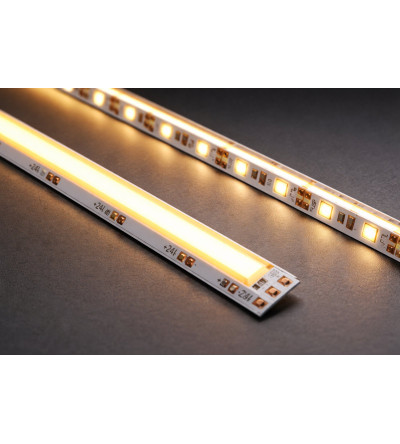
COB stands for Chip on Board. In practice, it refers to a construction method where very small LED structures are mounted directly onto a substrate at very high density, creating a more uniform light-emitting surface along the strip.
In LED strip applications, the most noticeable feature of COB is the continuous line-of-light effect. When the strip is visible directly, individual light points are much less pronounced than on many traditional SMD strips.
What is an SMD LED strip?
SMD stands for Surface Mounted Device. In this technology, LED packages are mounted on the surface of the PCB as separate components. It has been used on the market for many years and is thoroughly proven in real-world installations. SMD strips are widely available, familiar to installers and designers, and offered in a very broad range of versions.
That is an important point: SMD strips are a mature, tested and reliable solution. COB is an attractive development in the strip-light market, but it does not make SMD obsolete.
COB vs SMD – the main difference
The biggest difference is not simply that one is “new” and the other is “older”. The real distinction is the visual character of the light output.
- COB – typically provides a more uniform visual effect with fewer visible light points.
- SMD – more often shows individual points, especially at lower LED densities or in shallow profiles.
However, that does not mean only COB can deliver a clean linear lighting effect.
Can continuous light also be achieved with SMD strips?
Yes. This is a key practical point. A continuous line of light can also be achieved with SMD strips when the system is properly specified, especially through the right combination of:
- higher LED density per meter,
- a suitable aluminum profile,
- a quality milky or satin diffuser,
- adequate distance and depth between the strip and the cover.
In other words, COB does not have exclusive ownership of the “dotless line of light” effect. In many projects, a well-chosen SMD strip can also produce a very clean and professional result.
Advantages of COB LED strips
- More uniform visual light output – especially when the strip is directly visible.
- Reduced visibility of individual LED points – important in minimalist and architectural lighting.
- Strong visual appeal – highly valued in furniture, decorative and premium interior applications.
- Useful in shallow profiles – where the spotting effect of classic SMD strips is easier to notice.
Disadvantages of COB LED strips
- Shorter market history than classic SMD strips – it is a fast-growing category, but not as long-established as traditional SMD strip technology.
- Not always the best luminous efficacy per watt – this depends on the specific product and manufacturer.
- Potentially more challenging color consistency – which can matter in demanding projects.
- Not automatically the best option for every application – visual smoothness should not be the only selection criterion.
Advantages of SMD LED strips
- Long-proven technology – familiar, predictable and widely used.
- Very broad product availability – white, RGB, RGBW, tunable white, different voltages, outputs and configurations.
- Wide compatibility with profiles, controllers and accessories.
- A strong choice for practical and technical lighting applications, not only decorative ones.
- Capable of delivering a continuous line of light – when density and diffusion are specified correctly.
Disadvantages of SMD LED strips
- Visible LED points – especially on lower-density strips.
- The final visual effect depends more heavily on the profile and diffuser.
- In very shallow installations, COB is often optically easier to work with.
COB or SMD – which one should you choose?
If your priority is a smooth, directly visible line of light, COB is a very strong candidate.
But if you want a proven, widely available, predictable and flexible solution, SMD remains an excellent choice. This is especially true in installations where the strip works inside a profile with a diffuser and is not viewed from an extremely close distance.
The best conclusion is simple: COB should not be treated as an automatic replacement for SMD. COB has real strengths, but SMD is still a fully valid, mature and often optimal solution.
Conclusion
COB LED strips respond well to the market demand for smoother light and a more refined visual effect. That is their genuine advantage. At the same time, classic SMD LED strips remain highly relevant. They have been on the market for many years, they are proven, and they still offer a wide range of practical design possibilities.
That is why the right choice between COB and SMD should be based not on trend, but on the actual needs of the project: installation method, expected visual result, budget, accessories and technical requirements.
FAQ – COB LED strips
1. What does COB mean in LED strips?
COB stands for Chip on Board. In LED strips, it refers to a technology where very small LED structures are mounted densely directly on the substrate, creating a more uniform light output than many classic SMD strips.
2. How is a COB LED strip different from an SMD strip?
The main difference is the visual character of the light. A COB strip usually creates a more continuous line of light, while an SMD strip more often shows individual light points, especially at lower LED densities and in shallow installations.
3. Is a COB LED strip better than an SMD strip?
Not always. COB has a visual advantage when a smooth line of light is the priority. However, SMD strips are a proven technology that has been on the market for many years, widely available and highly versatile. The right choice depends on the application.
4. Can only COB create a continuous line of light?
No. A continuous line of light can also be achieved with SMD strips when LED density, aluminum profile and diffuser are selected correctly.
5. What are the main advantages of COB LED strips?
The main advantages are a more uniform light line, reduced visibility of LED points and a very refined visual effect in modern lighting projects.
6. What are the disadvantages of COB LED strips?
COB strips have been on the market for a shorter time than classic SMD strips, so they do not have the same long practical market history. Depending on the model, they may also not be the best fit for every project in terms of performance or cost-effectiveness.
7. What are the advantages of SMD LED strips?
SMD strips are a mature, proven and widely used solution. Their strengths include broad availability, compatibility with accessories and predictable performance in design and installation.
8. Where are COB LED strips especially useful?
COB strips are especially useful where the strip is directly visible and a clean, uniform lighting effect is important, for example in furniture lighting, decorative applications, niches and modern linear profiles.
9. Where are SMD strips still a very good choice?
SMD strips remain a very good choice for practical, technical, furniture and decorative lighting. They are often the right option when long-proven technology and wide configuration flexibility matter.
10. COB or SMD – which one should I choose?
If your priority is a smooth line of light, COB is worth considering. If you value a well-established technology with many years of market presence, broad availability and a wide range of options, SMD remains an excellent choice. The best decision always depends on the specific project.
Contact us to solve Your problem
Just click the right action
Same category
- What is color?
- LED Is More Than Efficiency: 5 Facts That Change How You See Light at Home
- SMD 3528 vs SMD 2835 – what are the differences and which LED strip should you choose?
- 5050 LEDs – types, power ratings, manufacturers and applications
- LED Panels in Technical Terms: Types, Parameters, Advantages, and Disadvantages