
Raster luminaires and LED panels – does retrofitting an old 4x18W luminaire still make sense?

4x18W raster luminaires were a standard solution for offices, schools and technical facilities for many years, but today they are increasingly being replaced by modern LED systems. In this article, we explain how a classic fluorescent raster luminaire is built, where energy losses occur, and what benefits can be achieved through professional LED retrofitting with branded LED modules and drivers.
Raster luminaires and LED panels – does retrofitting an old 4x18W luminaire still make sense?
Many offices, schools, corridors and technical facilities still use classic 4x18W raster luminaires with T8 fluorescent lamps. For years this was the standard ceiling lighting solution, but today the key question is different: is it better to keep the old technology, replace the whole fitting with an LED panel, or professionally retrofit the existing luminaire to LED?
The answer depends on the quality of the upgrade. A properly engineered LED retrofit of a raster luminaire, based on branded LED components, can significantly improve overall system efficiency, reduce power consumption and direct more light to the working area. This is where LED technology clearly outperforms the classic linear fluorescent system.
How is a classic 4x18W raster luminaire built?
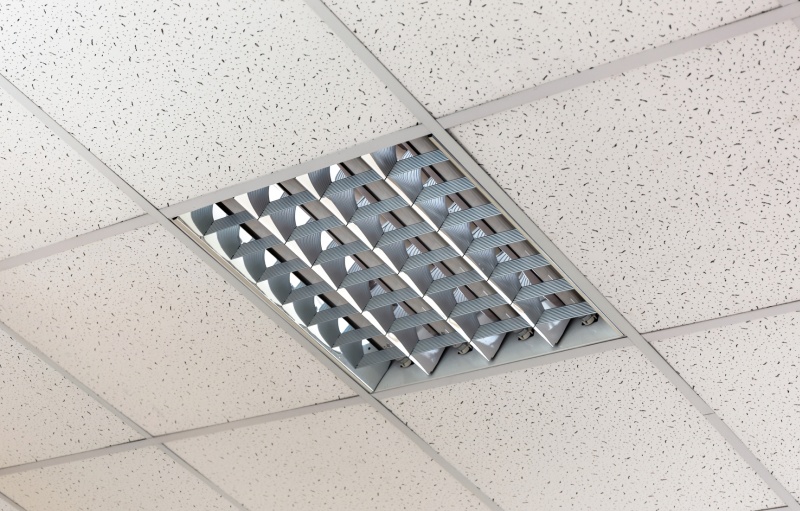
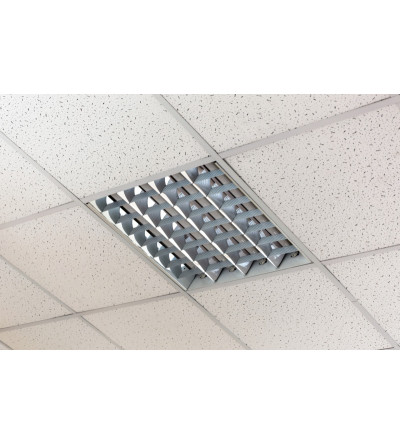
A typical 4x18W raster luminaire consists of a metal housing, reflector, louvre for glare control, four T8 18W fluorescent lamps, G13 lamp holders and control gear: either a magnetic ballast or an electronic ballast. The fluorescent lamp itself is an omnidirectional light source, so a considerable part of the luminous flux is not sent directly where it is needed, but first has to be captured and redirected by the luminaire.
This is the main weakness of the old raster fitting. Light is emitted around the entire lamp instead of mainly towards the task area. Part of the flux is lost inside the luminaire, part is reflected back, and the physical size of the lamp itself also blocks part of the emitted light. In practice this means the sum of lamp lumens is not equal to the useful output of the complete luminaire.
T8 18W fluorescent lamp efficiency – decent, but no longer modern
A standard T8 18W fluorescent lamp in a good triphosphor version typically delivers around 1350 lm, which is roughly 75 lm/W at source level. That sounds respectable, but in real operation you must also include losses in the luminaire optics and in the control gear.
If a classic 4x18W raster luminaire uses four such lamps, the sources alone provide around 5400 lm nominally. However, the complete luminaire does not deliver all of that flux into the room. In real systems, a significant part is lost due to reflections, shading and the limitations of raster geometry. As a result, the efficiency of the full luminaire is clearly lower than the lamp datasheet alone might suggest.
Magnetic vs electronic ballast – an invisible but important difference
Older luminaires very often use magnetic ballasts. This is a simple and durable solution, but it has an important drawback: additional power losses. In practice, the system consumes more electricity than the lamp wattage alone would suggest.
An electronic ballast performs better. It operates with lower losses, provides more stable lamp operation and improves the overall energy balance of the luminaire. As a result, two visually similar luminaires can have noticeably different power consumption simply because they use different control gear.
This matters in any upgrade project. If the installation remains fluorescent-based, switching from magnetic to electronic ballast can already bring a meaningful improvement. However, it still does not solve the core problem of fluorescent lighting: omnidirectional emission and optical losses inside the luminaire.
Why does LED work more efficiently in a raster luminaire?
LED modules work differently from linear fluorescent lamps. They do not emit light around a full cylindrical source. Instead, they emit light towards the useful side of the luminaire. This means the designer does not have to “recover” such a large part of the luminous flux from inside the housing. A greater share of the light is directed from the start to the desk, circulation area, workstation or display zone.
This is exactly why a well-designed LED retrofit can achieve a better lighting result despite lower power consumption. What matters is not only the lm/W of the source itself, but how efficiently the full system uses the produced luminous flux.
Professional retrofit with branded components – the Tridonic LLE example
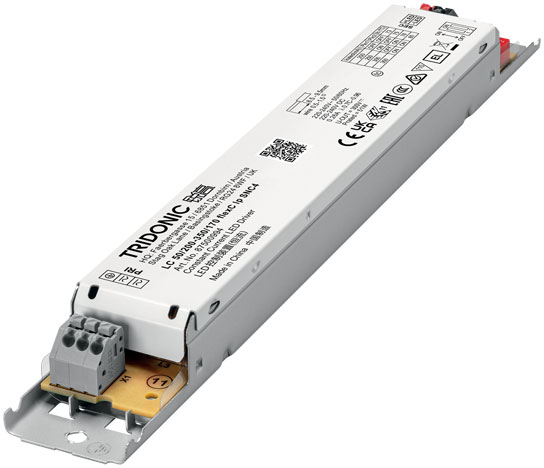
If the upgrade is intended to be professional, it should not be based on random replacement parts. A strong solution is to use branded linear LED modules such as Tridonic LLE. These components are designed for use in professional luminaires, panels and linear lighting systems.
Selected Tridonic LLE modules achieve efficiencies above 200 lm/W at module level. Combined with a branded LED driver operating above 90% efficiency, this creates a system that clearly outperforms a classic T8 fluorescent luminaire in terms of energy efficiency.
In practice, this means a well-executed retrofit can not only reduce power consumption, but also improve the utilisation of light, reduce optical losses and increase system lifetime. This is especially important in installations where luminaires operate for many hours every day.
Retrofitted raster luminaire vs LED panel
In many projects the investor compares two possible paths: rebuilding the old raster luminaire or replacing it completely with an LED panel. Both can be good solutions, but they serve slightly different purposes.
An LED panel is a convenient option when fast replacement, a new appearance, a slim profile and a ready-made product with declared performance are the priority.
A raster luminaire retrofit makes sense when the existing housing is solid, mechanically suited to the ceiling or interior layout, and the investor wants to keep the current fitting while upgrading to modern LED technology.
In a properly engineered retrofit, the result can be close to that of a modern LED luminaire while still using the existing mechanical structure and tailoring the performance to a specific site.
How much energy can be saved?
The scale of savings depends on the starting point. If the old luminaire uses magnetic ballast and the upgrade involves a complete LED retrofit based on branded components, the difference can be substantial. In practice, a realistic and honest energy-saving range is usually around 40% to 70%.
The best results are achieved when the project is not just about “putting LEDs inside”, but about engineering the whole system: module selection, driver selection, thermal design, mounting method and light distribution.
Why component quality is crucial
In professional lighting, the word “LED” alone guarantees nothing. The final result depends on the quality of the modules, the stability of their parameters, driver durability, thermal management and the way the retrofit is executed. Cheap components may look attractive in terms of price, but they often mean faster lumen depreciation, weaker consistency and greater failure risk.
That is why branded components and proper system design are the right direction for raster luminaire retrofits. It is an investment not only in lower power consumption, but also in stable light performance and longer luminaire lifetime.
Conclusion
The classic 4x18W raster luminaire is a technology that served the market for years, but today it loses to LED in system efficiency, light utilisation and operating cost. The T8 lamp itself is not the only issue – the bigger issue is how much energy and luminous flux the complete system wastes.
A well-executed retrofit based on branded components such as Tridonic LLE modules and high-efficiency LED drivers can transform an old luminaire into a modern, energy-efficient lighting system. In many cases this is more rational than keeping fluorescent lamps, and sometimes more cost-effective than replacing the entire ceiling integration.
If you are planning a lighting upgrade in an office, school, shop, hall or technical building, it is worth analysing not only the source wattage, but the efficiency of the complete luminaire. This is where the greatest saving potential is usually hidden.
FAQ – frequently asked questions
Is it worth upgrading a 4x18W raster luminaire instead of replacing it completely?
Yes, provided the housing is still in good condition and the retrofit is carried out professionally. LED retrofitting allows you to keep the existing luminaire body while significantly improving energy efficiency.
Does replacing only the ballast make a big difference?
It can bring a noticeable improvement, especially when changing from magnetic to electronic ballast, but it does not eliminate losses caused by fluorescent omnidirectional emission and old luminaire geometry.
Why are LED modules more efficient than fluorescent lamps in raster luminaires?
Because a larger share of their light is directed from the start towards the useful side of the luminaire. This reduces internal optical losses.
Does LED retrofitting always mean lower power consumption?
In a properly designed system, yes. The key is to maintain comparable lighting levels while using branded LED modules and a suitable driver.
What level of savings can be expected after retrofitting?
In typical projects, it is reasonable to speak about around 40–70% energy savings, depending on the starting point, operating hours and required light level.
Which is better: an LED panel or a retrofitted raster luminaire?
That depends on the application. An LED panel is a convenient new product, while retrofitting has a strong advantage where it is worth preserving the existing ceiling integration and adapting the upgrade to the specific installation.
Contact us to solve Your problem
Just click the right action